How to Avoid Summer Sleep Trouble

Summer used to be my favourite time of year. Late nights, barbecues with friends, lazy mornings. Since becoming a mother, my ideal summer has changed somewhat. Now I have the challenge of a child struggling with sleep. Here are my best 3 tips to help you survive the summer months and promote the best opportunity for sleep for your entire family.
Sleeping in the summer months can be tricky for everyone.

1. Darkness

Our bodies need darkness to produce melatonin. Melatonin is what makes us sleepy. During the summer months, it can still be light outside making it more difficult for your child to fall asleep. Try your best to use thick, block-out or blackout curtains in your child’s bedroom. This is also really important in the morning when the level of melatonin in our bodies is at it’s lowest. The smallest amount of sunlight can wake your child ready to start the day!

2. Temperature

If our bodies are too hot, we find it difficult to sleep. If your child has been running around, offer a lukewarm bath or shower to help drop their body temperature a little. Provide quiet, calm activities before bed.

If you live in a hot house like me, dress your little one in very light layers when they first go to bed. Later in the evening, you may want to add another layer over the top, because as the temperature drops in the early hours, you do not want your child to wake feeling cold. It can be really tricky getting the right balance so sometimes it is a bit of trial and error. For safe wrapping, visit here.

3. Avoid Over-Scheduling

This is a busy time for many families. With so many social events filling up our diaries, it can be hard to say ‘no’. I say everything needs to be in balance. If your child has had a late night or a day of missed naps, then the next day, try to stay closer to home and offer the best opportunity to catch up on lost sleep.

Our children’s bodies do need a certain amount of sleep each day. If that is reduced, then they carry a “sleep debt”. If that sleep debt if not addressed quickly, it will impact on your child’s sleep permanently. A child not sleeping is one tired and cranky household!!

The overall message here is be consistent with bedtime as much as possible. If there has been any missed sleep, make sure your child has a chance to catch up. Make sure your child’s environment is perfect to promote the best quality sleep possible.

Book in a time to chat with me here.


Sleep well!

Janelle Jeffery Child Sleep Consultant for Sleepytime
Janelle Jeffery
Child Sleep Consultant for Sleepytime
 

Top 4 Sleep Aides for Children

In my previous blog post, I wrote about 3 types of sleep gadgets to avoid that could actually prevent your child from sleeping soundly. If you didn’t read it, follow the link here.

Sleep aides can help promote sleep.

In this blog post I will share my top 4 sleep aides that can encourage your child to sleep a little better. With anything, I do like to keep things simple and I only introduce something if it is needed. Less is more when it comes to sleep.

1) Blackout blinds. A blackout blind or really thick curtains is a “must” in any child’s room. Darkness is needed for your body to produce melatonin. Melatonin is what makes you sleepy. With the summer months upon us, having a dark space to fall asleep at night BUT most importantly for morning, can help your child to sleep longer. Even the smallest peep of light in the wee hours can wake your child ready to start the day. Blinds can help with early risers.

2) Sleeping bags. I am a huge fan of sleeping bags for nights and naps, and they can be used from 3months of age right up to 3years. There are so many options available on the market allowing you to choose the perfect ‘tog’ (cloth weight) for your home environment. Every home will have a different room temperature so be guided by this. Sleeping bags help children to stay warm (not hot or cold) and snuggly though out the night. Sleeping bags are also recommended by SIDS and Kids. An added bonus is that sleeping bags can at times prevent children from climbing out of the cot.

3) A Sleeping Buddy. A small, soft, cuddly toy can help babies and children to wind down and fall to sleep. A sleeping buddy can help to resettle during the night or to extend a short nap. Children are tactile and need to feel, touch, smell and taste. Having a sleeping buddy can provide all of these. Many children do not bond with one because their sleeping buddy is a parent. Some children just do not want anything to sleep with and that is ok. Some children may not have a sleeping buddy until 3years or older. A sleeping buddy can help older children when they are feeling scared in the night. Introducing a soft toy into a cot or bed needs to be at the discretion of the parent as it can increase the risk of SIDS.

4) A Sleep Clock. If used consistently, a sleep clock can help children know when they need to stay in bed and when it is time to get out of bed in the morning. Children are governed by their internal clock and do not know when it is time to get up or not. A child doesn’t know the difference between 5am and 7am. A sleep clock is a visual clue and can take some pressure off you as it’s the sleep clock that says “stay in bed” and not you being the bad guy. A sleep clock will only work if you stick with the time. If you allow your child to get up even 5mins before the clock says it’s time to get up, you are opening the opportunity for an earlier and earlier start.

With any sort of sleep aide, they are only there to enhance the opportunity for sleep. Sleep aides may not make your child sleep longer and they cannot stop your child from waking up through the night. Sleep is a complex issue. If you would like more advice, then book in a time to chat here.

**If you wish to support an Australia online baby store visit Dream Child Emporium to purchase your sleep products.

Sleep well.

Janelle Jeffery Child Sleep Consultant for Sleepytime Child Educator and Behaviour Specialist.
Janelle Jeffery
Child Sleep Consultant for Sleepytime.


Baby sleep gadgets to avoid!

Sleep Gadgets to Avoid!

There is an endless stream of gizmos and gadgets on the market that promise to help your baby sleep. To be honest I have bought a few dud things that seemed like a great idea at the time. Here are a few gadgets to avoid as they can actually prevent your baby from sleeping well.

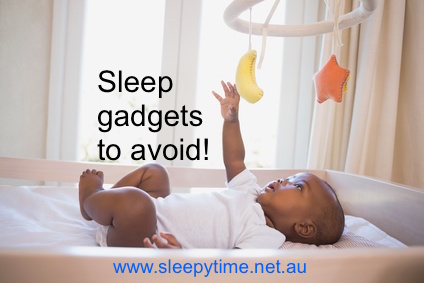
1 – Hanging mobiles. They look beautiful in a nursery. In fact they can be very useful – but not for sleep. As parents we think, “oh it would be so nice to watch it go around and around then fall asleep”. Well the opposite can happen. Mobiles stimulate your baby’s brain ready for play instead of winding down ready for sleep. Mobiles are wonderful hanging over the change table when you need to distract and entertain your baby whilst you have your hands full.

2) Flashing Lights. Electric aquariums or twinkling star shows, night lights with rotating colours can actually keep your baby awake. You want the room to be ‘’boring” and dark to promote good sleep.

3) Music machines. I am talking about anything that plays a song. Music has rises and falls and this could actually wake your baby when they are trying to drift off to sleep. If your baby has fallen asleep with music playing and the CD has stopped, they may wake wondering where the noise has gone. If you need anything at all, ‘white noise’ is a better choice as it is constant and unchanging.

If you have fallen into the trap of the bedtime circus, it is time to remove everything and get back to basics. The best ways to help your baby sleep are:

1               Routines

2               Sleep Cues

3               The opportunity to sleep independently

Easier said than done right? My philosophy around bedtime and ‘sleep devices’ is – keep it simple! If your baby is having difficulty sleeping, buying a gadget or gizmo will only put a bandaid on the problem and not tackle the root of the issue.

If you want your baby to sleep unassisted but feel confused or worried about where or how to start, I am here to help!!! Contact me here.

If you’re looking at what sleep products I do recommend, read more here.

Janelle Jeffery Child Sleep Consultant for Sleepytime Child Educator and Behaviour Specialist.
Janelle Jeffery
Child Sleep Consultant for Sleepytime
Child Educator and Behaviour Specialist.


6 Daylight Saving Sleep Tips!

Many of you twice year need to prepare yourselves for daylight savings. As an adult this can be hard enough, but trying to tackle it with a child’s sleep schedule to consider and be a nightmare!! Here are some quick tips to help with the transition…

Surviving Daylight Savings!

Daylight Savings 

  1. For a gentle approach, adjust the time by 10-30minute increments every 3 days. Depending on your child’s ability to stay awake without becoming too overtired will determine the speed at which you make the change. Every child is different so you need to watch and observe. This gentle time change applies at the beginning and end of daylight savings.
  2. If you are brave, change to the new time immediately but this can cause overtiredness. For a little while you child might protest at sleep time or cat nap. Hang in there and don’t panic. The more you try to “fix” things, the more problems you could create.
  3. Watch for tired signs especially at night. An overtired child will have difficulty falling asleep and staying asleep. Due to the change in sleep schedule, your child may experience night wakings for a short period too. Again, don’t panic! Let things rectify on their own.
  4. Be patient. Change takes time. It may take up to a month for your child’s body to fully adjust.
  5. Early morning wake ups. Try really hard to keep your little one in bed until a reasonable wake up time. These wake ups may be the most difficult so hang in there, it will get better.
  6. Use light and darkness to your advantage. Use lots of sunlight and fresh air to stay awake, use darkness to get to sleep.

The biggest thing to avoid for yourself and for you child is to constantly refer to the “old time”. The quicker you move to the new time the better it will be for all of you.

Janelle Jeffery Child Sleep Consultant for Sleepytime Child Educator and Behaviour Specialist.
Janelle Jeffery
Child Sleep Consultant for Sleepytime.

My daughter sucks her fingers!


Sucking fingers or a thumb is a self-soothing strategy.

Before I became a parent I had this mental list of “my child will never…” One of those specifically was “my child will never suck their thumb.” I was really against it and thought it was a “bad habit” kids had.

Once Emily arrived she quickly refused the dummy and decided to suck her fingers instead. I guess technically it wasn’t her thumb!! At first I was really concerned as I had images of my beautiful little girl having horrendous bucked teeth.

Once learning more about infant sleep, I realised that finger and thumb sucking was in fact the perfect “self-settling tool” as the sucking sensation calms and soothes. It was something she could do for herself. Emily was an excellent sleeper and the finger sucking was only for sleep, not all through the day.

Fast forward and Emily is now 5. Recently we visited a dentist and we were told her front teeth were starting to move forward. She advised us that stopping this habit was best done prior to her permanent teeth coming though.

I was dreading tackling this issue because Emily was such a great sleeper and I didn’t want to mess with that, also I didn’t want her to be upset. I’m such a wimp!

So operation finger sucker began…

1)    Talk – In the lead up to preventing Emily from sucking her fingers during the night we talked a lot about why we needed to stop the habit. I showed her a couple of pictures of children on the Internet that had bucked teeth. This wasn’t to scare her but to help explain what we were trying to prevent.

2)    Reward – We talked about what we could do to reward her for not sucking her fingers. She decided she wanted to have earn a lolly every morning she didn’t suck her fingers. After 10 mornings, she wanted to go ten-pin bowling. Yep, I wouldn’t have picked that one!

3)    Begin small – For a fortnight before starting, Emily stopped sucking her fingers during story time. This was difficult but not impossible for her. Giving lots of praise was crucial.

4)    Tool – I decided Emily needed a tool to help her, as just asking her to not suck her fingers would be impossible plus I couldn’t watch her all through the night to check. I bought a “T-Guard™” which is basically a device that slips over the fingers (or thumb) to prevent suction. It is this suction that is comforting and pleasurable for children. It is the suction that pulls the teeth forward.

So with everything in place, we started “operation finger sucker”. I am shocked that Emily is doing so well. We are 5 nights into it and so far so good. Not being able to monitor everything that is going on is tricky, so I have to hope that it is working. I wish I had a video monitor!!

Emily is not thrilled about no longer sucking her fingers but she is settling really well at night and after a few early mornings, she is right on track. She is excited every morning to get a lolly in her bag plus a step closer to bowling. It is recommended she wear the guard for 45 nights so I guess we have a long way to go.

Sleep well.

Janelle Jeffery Child Sleep Consultant for Sleepytime Child Educator and Behaviour Specialist.
Janelle Jeffery
Child Sleep Consultant for Sleepytime.

Help your child to love sleep