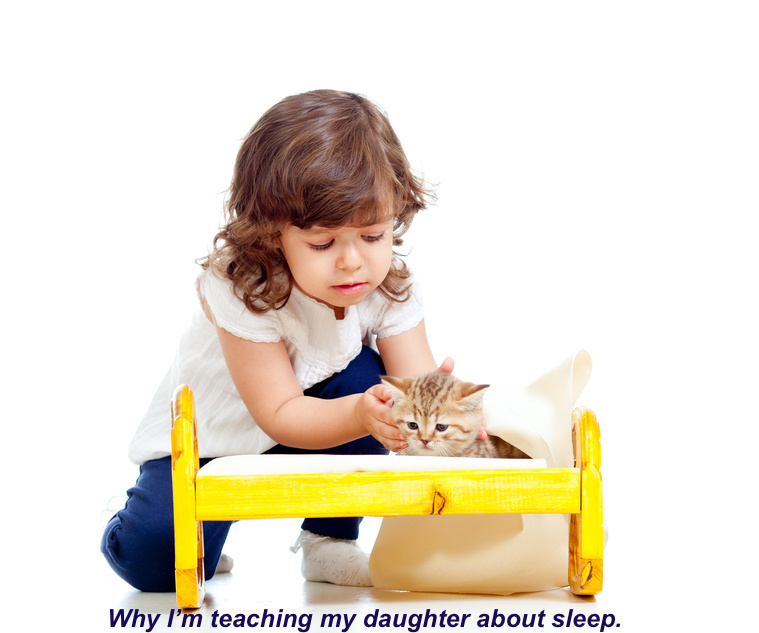
One hour ago I learnt a really huge lesson from my daughter. I learnt how to be a better parent.This is our story.
Miss E (6years) needed to bring a handkerchief to school for a prop for a dance they were doing. She was so excited because she had a special one her Grandma had given her for Christmas last year.
Two days ago Miss E mentioned that she realised that someone might take her handkerchief accidently or it might get lost. I said “Don’t worry, I’ll give you some fabric instead.”
Last night I put her to bed then went to find a piece of fabric. Chore complete, problem solved – tick!
Thirty minutes later Miss E came out of bed to find me. She was crying. She told me that she couldn’t sleep because she was worried about the handkerchief. Normally I would have said “don’t worry, it’s fine, go to sleep,” but I didn’t. I felt she needed more from me. I showed her the piece of fabric in her bag and on the way back to bed I explained we would go into class together to swap the handkerchief. She seemed happier. I tucked Miss E into bed then said, “hand me your worry.” Miss E placed her hand on my forehead and we kissed each other goodnight. I left.
This morning Miss E woke happily, we got ready for the day, then walked to school as normal.
THIS IS WHEN THE MAGIC HAPPENED…. Miss E stopped then said,
“Mummy, when you took away my worry, you took away ‘the think’ too.”
“The think?”
“Well, I stopped worrying but sometimes I still think about it. Last night you took the worry and the think. I fell asleep after that.”
This-just-blew-me-away. What I thought was a tiny little thing, really made a huge impact on both of us. This is what I learnt…
Worry and/or over-thinking impacts sleep no matter what age you are.
A worry may be insignificant to you but it can be a mountain to someone else, especially kids.
Words don’t fix things, actions do. Always follow though.
Don’t underestimate kids. They are smarter, wiser and more emotionally grounded than we give them credit for.
Parenting is a journey and today reminded me that Miss E and I are in this together.
Janelle Jeffery -Sleep Consultant; Child Educator; Writer and most importantly a Mummy!
I hear many, many reasons why parents transition their child from a cot to a bed earlier than the recommended age of 2.5-3years. I believe that a child younger than this is unable to completely understand the rules around bedtime. It is typical for toddlers to test boundaries and refuse bedtime. Frequent night waking, refusing bedtime and becoming clingy are all normal turn of events. Many parents feel that transitioning their child from a cot to a bed will solve the sleep problem. I disagree. Here are the 5 most common reasons why parents transition their children before they are ready.
# 1 My child HATES his cot?
I find this to be pretty untrue. No child hates their cot and why would a bed be any different? Addressing the underlying cause for this belief is crucial before the cot to bed transition takes place.
# 2 My child climbs out of his cot.
Yes this is really difficult because your child’s safety is paramount. Climbing out is unsafe but so is unrestrained access to the entire house during the night without your supervision. Climbing out of the cot does not mean he hates it either. He is testing boundaries here. There are lots of strategies to trial before you ultimately decide to transition to a bed. Read my blog here on cot climbing.
# 3 I need the cot because I am pregnant.
I know having 2 cots isn’t ideal but I would personally rather this than having a newborn waking frequently through the night to feed plus having a toddler running around the house at all hours. Depending on the age difference between your children, your newborn may sleep in a bassinet at first giving your eldest more time in the cot. You can also use a travel cot or portacot for your youngest if there are only a few months to wait. Having two cots is not the end of the world if it means your children and you are all sleeping well.
# 4 My child is toilet trained overnight, the cot has to go.
Getting up in the night to lift your child out of the cot to go to the toilet is tiring – I get it. My daughter was in a bed when she needed the toilet during the night and yes I did have to get up to her. She followed the bedtime rule of calling out instead of getting out. This is for such a short period of time until your child can hold out all night. It is much safer for you to go with him to the toilet overnight regardless if he is in a cot or a bed. For more information regarding toilet training and sleep, read my blog here.
# 5 My child sleeps on the floor at day-care. He must be ready to do this at home.
“Monkey see, monkey do” comes to mind. Children will follow other children’s lead. Day-care and Nursery providers are truly amazing creatures. How they manage to get 10-15children to sleep on the floor at the same time is incredible. Childcare centres often need to transition toddlers to a mattress on the floor for naptime because they do not have the facilities to accommodate so many cots. Children can sleep successfully on the floor at day-care but this does not mean they are ready to do that at night – all night. You can continue to keep your child in his cot at home until 3years of age even if he sleeps elsewhere during the day from the age of 2years.
If you do feel your child is ready to transition from a cot to a bed, click here to read about how to ensure a smooth transition.
If you have already transitioned your little one and things are not going great, please get in touch here.
Sleep well,
Child Sleep Consultant for Sleepytime
Do you want to read more about children and sleep? Here are other posts you may be interested in.
Teach your child about the importance of sleep here
Does your child have separation anxiety? Read here
Do you want to reduce the battle at bedtime? Read here
Do you think your child is ready to drop their nap? Read more here
I was so excited when it was time to transition my daughter from the cot to a bed. I researched it a lot. Well there were so many different styles of beds to choose from, was I going to keep the same theme in her room or change it? What linen did she need? What sort of mattress should I buy? Pillows? Do I get a couple of throw cushions too? Storage? Should I get matching drawers? Oh, so many questions, so much to consider, oh such fun!!
WHOA – HANG ON A SEC!
Yes, it is an exciting time when your little one is getting ready for a big bed, but is he really ready yet? Read this first to ensure a smooth transition for everyone.
When is the right time?
A big mistake you can make is to transition your child into a bed before he is ready. If you do move your child before he’s ready then often disaster will strike. You have a child battling bedtime and/or up all through the night. There is often a honeymoon period where your child goes to bed easily, sleeps through the night and you are all high fiving each other. After a few nights, weeks or months your child suddenly realises this new freedom and will happily explore his options.
I recommend…
Ensure your child is a great sleeper in a cot before you move him to a bed. If not, the problems will just transfer to the bed and it will be harder to rectify.
Wait until your child is 2.5years MINIMUM but hold off to 3years if you possibly can. Children younger than this are unable to completely understand the rules around bedtime and it will take longer to reinforce this.
The Next Step…
So you have a champion sleeper and his 3rd birthday is on the horizon. Here are some tips to help with a smooth transition.
1) RULES –
Sleeping in a big bed is a massive change for a child. Being a ‘big kid’ comes with responsibilities.
Golden Rule #1 “You cannot come out of bed until morning.”
So when is morning? You can either purchase a sleep clock of some kind; or the rule can be modified to “You cannot come out of bed until I come and get you in the morning.” If you go with option 2 and decide to not use a sleep clock, you must set a specific “getting up time” and stick with it. You cannot expect your child to get up at 6am one morning then 7am the next and be happy about it. A child is more likely to get out of bed in the early hours of the morning.
Golden Rule #2 is “If you need me in the night, call and I will come to you.” Never allow your child to come out to you because the first time he does this, and he is rewarded with attention, you will give him a green light to do it all the time. You child may test you by calling out over and over again. Annoying, but normal. If this is the case, tell him that this is the last visit and you will see him in the morning. Ignore all other calls.
2) BOUNDARIES –
Have a very clear and predictable bedtime routine. This is the same regardless if your child is in a cot or a bed. Children like visual prompts such as a bedtime routine chart. Click here to download.
Teamwork is important too. Same rules applies regardless of which adult is in charge!
3) PREPARE YOUR CHILD –
Before the big event, allow your child to be part of the excitement. Talk about the big change that is about to happen. Maybe he can come bed shopping with you? Maybe he can choose between 2 types of duvet/doona cover or sheets. Possibly he can pick out a reading lamp. I would avoid making it a surprise just in case it backfires. Some children do not handle change well, so building up to the change may need to take a few weeks or even a month depending on the temperament of your child.
4) PREPARE YOURSELF –
So how are you going to react when your little one does get out of bed? Trust me, it will happen at some point so if you prepare yourself before it happens then things will run a lot smoother. Attention positive or negative is still attention, so stay calm. Remind him of the bedtime rules of staying in bed and walk him back to bed. Be consistent, be consistent, and be consistent! You may need to repeat this over and over again. Depending on your child, it may take time for him to understand that you really mean “stay in bed until morning.” Toddlers and children need to test boundaries. It is your job as the parent to demonstrate that the rules will not change.
5) MORNING TIME –
Keep morning time the same as when your child was in his cot. If you are using a sleep clock, if you do not stick with the set time (even if it’s a minute to go) you will open a huge can of worms. Your child will think it is fine to get out at other times during the night. I repeat – Consistency is key! .
I transitioned my baby at 18months of age and everything was fine. Your child will be fine too.
I hear this all-the-time. Many well-meaning friends will advise you to transition your child earlier than is recommended. Their child was fine so why shouldn’t yours? You will certainly here this advice if your child is having trouble sleeping. If you or your friend have managed to transfer a child earlier than 2.5years and were successful, I take my hat off and say, “Wow you won the lottery there. Awesome and good for you!”
To read about the 5 most common reasons parents will transition their child from a cot to a bed earlier, click here.
My biggest piece of advice I can give you – don’t be persuaded to transition your child from a cot to a bed before your child is ready. I have had many people raise their eyebrows in horror when I say that 3years is the most ideal age to move to a bed. If you can wait it out, prepare your child, prepare yourself before you go for it – you will be much better off in the long run.
One final thought – sometimes things don’t go to plan. There will be some children no matter what foundations are laid will quite frankly rebel. Though disheartening, there are things that can be done to enable children to stay in their bed all night. If this is you, then it may be time to get a professional on hand. Contact me here to book in a time to chat.
Good luck with the transition! It can be a little daunting at first as change is hard on everyone. Remember this is an exciting time too. Enjoy it! I followed this exact advice and we have never had a nighttime visit. My daughter is now 6.
Sleep well,
Child Sleep Consultant for Sleepytime
Do you want to read more about children and sleep? Here are other posts you may be interested in.
Teach your child about the importance of sleep here
With this series of blog posts, I will be giving a brief background on a specific method of sleep training and share some pros and cons of each. My aim is to educate and inform, not to throw criticism towards any parent who may choose a specific method. I just want to be clear that there are many forms of sleep training methods (many I won’t be covering) so you need to choose the best strategy for your specific child.
This method is very much about the attachment parenting philosophy and co-sleeping.
What is the No Cry Method?
The No Cry Method is an attachment parent philosophy of changing sleep habits whilst ensuring your baby does not cry at all. American Paediatrician, William Sears, author of many attachment parenting books including The Baby Book; Elizabeth Pantley TheNo Cry Sleep Solution and Pinky McKay Sleeping Like a Baby are all attachment parenting advocates who do write about baby sleep.
Interestingly the No Cry Method isn’t a specific approach like The Extinction Method, Ferber Method or Camp Out Method because attachment parenting often shies away from any sort of sleep training at all.
I have not personally used this method so I will give a brief overview and if you would like to know more, I recommend purchasing the books from the experts above.
What does the No Cry Method aim to achieve?
The goal is for the baby to have lots of assistance to fall asleep through feeding, rocking, cuddling and most importantly the emphasis is to continue to co-sleep. The aim is to reduce the help offered by the parent but to not fade it out completely. Many parents who choose this method wish to continue to co-sleep but want their baby sleep for longer stretches at night.
So how does the No Cry Method work?
Your baby’s wants are put first at all times. If the baby wants to be fed, rocked, cuddled to sleep, then it is offered.
By sleeping with and attending to your baby’s cry, the sacred bond is secure.
If your baby comfort sucks during the night, and you want to reduce this, you slowly try and unlatch your baby. If your baby reattaches, you try to gently unlatch them again. Repeat. You can also try to fade out rocking and patting in the same way. Over time you very slowly reduce the amount you offer this. If your baby begins to cry, you keep rocking, patting, then try again to stop the help. Repeat.
This method can make many months to see any change to your baby’s sleep.
Cons of the No Cry Method
It is a very, very, very slow approach to change. You may become frustrated and “give up” as progress takes many, many months.
Your baby may not respond to this very gentle method and some babies do not make any progress at all.
Your relationship with your partner may become strained if one parent does not want co-sleeping to occur.
You cannot 100% confirm that there will be no crying at all.
This method can be very fluid so you may become frustrated at the lack of step-by-step guidelines.
Pros of the No Cry Method
You can continue to bed share.
You can continue to night-feed.
You are able to offer physical and verbal comfort so it’s a very hands-on approach.
It is a very gentle approach to change.
It is inline with the attachment parent philosophy.
Final thoughts from me…
When choosing a method of sleep training it is important to remember that the approach is only one piece of the puzzle. Finding the cause of the difficult sleep comes first. Next you need to establish positive sleep cues for your baby. Lastly comes the sleep training method. With any sleep training method, it is really important to listen to your baby. When families work with me, quite often the method changes and evolves depending on how the baby is coping and the signs he is giving me.
The forms of sleep training methods that will be covered in this 4 part series are: The Extinction Method, The Ferber Method, The Camp Out Method and the No Cry Method.
Janelle Jeffery Child Sleep Consultant for Sleepytime
Being a child sleep consultant there is a lot of talk at the dinner table around what I do, so you would be right to think that my daughter Emily is and has always been, a perfect sleeper. Well that just isn’t the case.
In fact I still have this image burnt in my brain of Emily (3 at the time) standing in the bathroom half undressed, tantrum in full swing, and me on my bed crying having a time out. I hated the lead up to bedtime, and so did she. Every night the battle was on. We were both left with wounds even though the end result was her finally falling asleep. No one walked away a winner.
It was getting so horrendous that after dinner, I would pounce on her kicking and screaming (that was both of us!!) whilst trying to navigate the stairs to the bathroom to rip the clothes off her tiny body. Boy she was strong. I would talk to Emily through gritted teeth and basically threaten her that I would send her to bed without a story or a kiss or even pyjamas. She would need to sleep naked! Bedtime was a punishment for both of us.
Hindsight and knowledge are wonderful things because once we finally passed that phase (not quite sure how I did it to be honest as there was a lot of wine consumed during that period) I realised that I needed to teach my daughter about sleep. Sleep should not be a punishment but a lovely reward after a busy day. I looked at sleep that way so why couldn’t she?
How to teach your child about sleep
#1 Tired signs
If your child is getting ratty, being naughty or is having a tantrum AND it is close to a sleep time, tell him “your body is telling me that you are getting tired. I get frustrated/angry/upset/etc when I am tired too.” No child likes to hear, “you are tired.” By commenting on what his body is telling him, takes it away from being a personal attack. It is not his fault he is behaving that way – he’s tired. By telling him that you feel like that too helps him understand that it is normal. This also enables him to begin to recognise the signs of being tired. I love it when Emily says to me “I am tired mummy, I think I need to go to bed.”
#2 No surprises
The element of surprise will only backfire at bedtime. Imagine you are watching your favourite show and your partner switches off the TV and sends you to bed. You would be mighty angry! Children need to be warned that playtime is at an end and bedtime is approaching. Set a timer for 5minutes and once it’s time, playtime is done.
Stick to the same bedtime routine each and every night. A bedtime routine’s job is to send a message to our body that is it time for sleep. If there is no consistent routine, then your child is missing out on that vital sleep cue.
#3 Communication
Talk through the bedtime routine. Some children need step-by-step guidance. These can be one word prompts like “toilet, clothes off, bath, teeth, pyjamas, etc.” There is a lot of research out there stating boys process information differently to girls. If you overload your son with long, wordy instructions, you are likely to hit resistance. Less talk more action applies here. You can download a visual bedtime chart here or make your own.
Explain to your child (not when they are having a meltdown!) why sleep is so important. Make it simple and explain it in a way that is age appropriate.
Sleep is Awesome because…
Sleep makes our hearts happy.
Sleeps helps us to grow.
Sleep helps our body to fight germs.
Sleep helps us to balance and not fall over.
Sleep gives our brain power to think.
Sleep gives us energy to play and have fun.
#4 Punishment
As soon as you make bedtime a punishment, you are always going to be faced with a battle. Sending a child to bed after explaining they are showing their “tired signs” is one thing, but sending them to bed for hurting their sister is the wrong message you want to be giving. If you do need to offer a “timeout” I would recommend using a different room in the house.