One hour ago I learnt a really huge lesson from my daughter. I learnt how to be a better parent.This is our story.
Miss E (6years) needed to bring a handkerchief to school for a prop for a dance they were doing. She was so excited because she had a special one her Grandma had given her for Christmas last year.
Two days ago Miss E mentioned that she realised that someone might take her handkerchief accidently or it might get lost. I said “Don’t worry, I’ll give you some fabric instead.”
Last night I put her to bed then went to find a piece of fabric. Chore complete, problem solved – tick!
Thirty minutes later Miss E came out of bed to find me. She was crying. She told me that she couldn’t sleep because she was worried about the handkerchief. Normally I would have said “don’t worry, it’s fine, go to sleep,” but I didn’t. I felt she needed more from me. I showed her the piece of fabric in her bag and on the way back to bed I explained we would go into class together to swap the handkerchief. She seemed happier. I tucked Miss E into bed then said, “hand me your worry.” Miss E placed her hand on my forehead and we kissed each other goodnight. I left.
This morning Miss E woke happily, we got ready for the day, then walked to school as normal.
THIS IS WHEN THE MAGIC HAPPENED…. Miss E stopped then said,
“Mummy, when you took away my worry, you took away ‘the think’ too.”
“The think?”
“Well, I stopped worrying but sometimes I still think about it. Last night you took the worry and the think. I fell asleep after that.”
This-just-blew-me-away. What I thought was a tiny little thing, really made a huge impact on both of us. This is what I learnt…
Worry and/or over-thinking impacts sleep no matter what age you are.
A worry may be insignificant to you but it can be a mountain to someone else, especially kids.
Words don’t fix things, actions do. Always follow though.
Don’t underestimate kids. They are smarter, wiser and more emotionally grounded than we give them credit for.
Parenting is a journey and today reminded me that Miss E and I are in this together.
Janelle Jeffery -Sleep Consultant; Child Educator; Writer and most importantly a Mummy!
With this series of blog posts, I will be giving a brief background on a specific method of sleep training and share some pros and cons of each. My aim is to educate and inform, not to throw criticism towards any parent who may choose a specific method. I just want to be clear that there are many forms of sleep training methods, many that I won’t be covering, so you need to choose the best strategy for your specific child.
This method isn’t for the faint hearted.
What is the Extinction Method?
The Extinction Method, often regarded by sleep professionals as the “cry-it-out” method, because in a nutshell, a baby is left to cry themselves to sleep with no interaction or reassurance by the parent.
American paediatrician, Dr Marc Weissbluth, author of “Healthy Sleep Habits” is the biggest advocate for this type of sleep training. Interestingly this method is popular with paediatricians and doctors because it is often the only method familiar to them.
What does the Extinction Method aim to achieve?
The goal is for your baby to fall asleep independently, without any help from an adult, at anytime. It eliminates any negative sleep associations like rocking, feeding to sleep, dummy/pacifier, cuddling to sleep etc very quickly.
So how does the Extinction Method work?
First of all, preparation is key. Make sure your baby…
Isn’t overtired.
Is well.
Has a cool, dark, quiet place to sleep.
Has a bedtime routine.
After the bedtime routine, you place your baby into the cot – AWAKE. The next step is to leave the room and never some back until morning time.
This method suggests that if you do come back into the room at anytime, your baby will become more distressed or stimulated and learn that if they cry, you will come and rescue them. These visits will encourage excessive, prolonged crying.
Cons of the Extinction Method
This sleep training method is the most extreme and controversial. It isn’t for the faint-hearted.
This method can be very distressing for the baby and the parents because there is no form of comfort or reassurance permitted.
This method doesn’t allow for mishaps like a dirty nappy, vomiting or being stuck in the cot rails. It is not recommended for a baby who needs to continue to feed during the night.
This method is not suitable for children in a bed because it is very likely your child will follow you out of the room.
Pros of the Extinction Method
Some babies and children want “all or nothing” meaning if you are not going to feed, rock, let me have a dummy etc then I want to be left alone thank you very much!! Any sort of gentle or medium sort of comfort can be more unsettling for some children so this method is often the last resort.
It can be very quick. Some parents claim that their baby is sleeping through the night after 2-3nights of implementation.
Final thoughts from me…
Before deciding to use this method, I recommend starting with a more gentle approach then moving towards the Extinction Method if that strategy isn’t working.
I do not recommend using this method for babies who need to continue to have feeds during the night as this can lead to feeding issues and weight complications. If unsure, speak to your doctor or health nurse professional first.
When choosing a method of sleep training it is important to remember that the approach is only one piece of the puzzle. Finding the cause of the difficult sleep comes first. Next you need to establish positive sleep cues for your baby. Lastly comes the sleep training method. With any sleep training method, it is really important to listen to your baby. When families work with me, quite often the method changes and evolves depending on how the baby is coping and the signs he is giving me.
With this series of blog posts, I will be giving a brief background on a specific method of sleep training and share some pros and cons of each. My aim is to educate and inform, not to throw criticism towards any parent who may choose a specific method. I just want to be clear that there are many forms of sleep training methods (many I won’t be touching on) so you need to choose the best strategy for your specific child.
Camp out Method of Sleep Training is gentle and very hands on.
What is the Camp Out Method?
To be honest, I am unsure as to the exact origins of the “Camp Out” Method of sleep training. It certainly similar to The Ferber Method of sleep training but with a difference. It can be another variance of “controlled crying” but has a more hands, gentle approach. This method may also be known as “The Sleep Lady Shuffle” devised from Kim West author of The Sleep Lady’s Good Night Sleep Tight. Another version of this method is “Stay in the Room” devised by Dana Obleman author of The Sleep Sense Program. Another name is the “Gradual Extinction Method.”
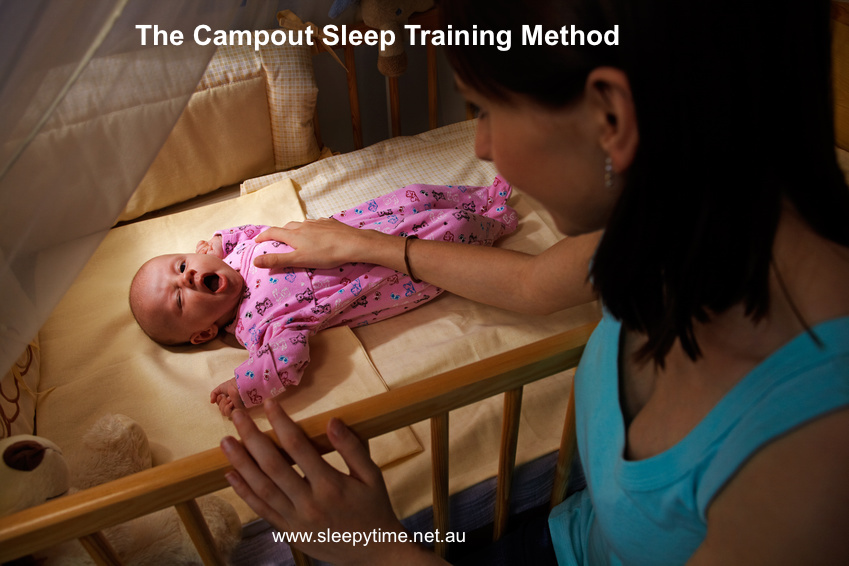
The Camp Out Method of sleep training enables you to be in the room with your baby offering lots of support and comfort. Over 10-14days, you gradually move away from your baby’s cot and fade out any verbal and physical reassurance given.
What does the Camp Out Method aim to achieve?
The goal is for your baby to fall asleep independently, with moderate to lots of parent intervention that is faded out over a period of time. It is a gentle approach to change because you are very present through the process. It eliminates any negative sleep associations like rocking, feeding to sleep, dummy/pacifier, cuddling to sleep etc.
So how does the Camp Out Method work?
First of all, preparation is key. Make sure your baby…
Isn’t overtired.
Is well.
Has a cool, dark, quiet place to sleep.
Has a bedtime routine.
Has a sleep phrase introduced.
You have a mattress or chair that can be moved easily.
With this method, you place your baby into the cot, awake as possible, and lie on the mattress or sit in the chair. You may offer physical touch, pick your baby up for a cuddle and offer verbal cues until your baby is asleep. Once your baby is asleep you can leave the room. Every few nights or so you gradually move your mattress or chair away from your baby’s cot. You also fade out any oral and verbal comfort.
The Camp Out Method can take between 2-3weeks for your baby to be able to sleep independently. Progress can be slower compared to The Extinction Method and The Ferber Method.
Cons of The Camp Out Method
Your baby can cry a lot more with this method compared to The Extinction Method and The Ferber Method. Babies often cry more when their parents are present in the room. Cortisol levels (stress hormone) are lower or non-existent but the cry can appear more intense.
Your baby may become more stimulated and/or irritated with you being in the room.
Your baby may not respond well to the verbal and/or physical contact when falling asleep.
You may find it more stressful seeing your baby cry compared to hearing it from afar.
You may need to stay with your baby for a long period of time before your baby falls asleep.
This method is hard to execute if you have other children needing your attention at the same time.
Pros of The Camp Out Method
You can continue to room share.
You can continue to night-feed.
You are able to offer physical and verbal comfort so it’s a very hands-on approach!
It is a gentle approach to change.
As you are present in the room, you are able to see exactly how your baby is responding to the change and you can support them through it.
This is a good method for older children who try to escape from their room or have separation issues.
Final thoughts from me…
This is a really good method as it accommodates babies and children from about 4months of age. I like how hands on and responsive it is.
When choosing a method of sleep training it is important to remember that the approach is only one piece of the puzzle. Finding the cause of the difficult sleep comes first. Next you need to establish positive sleep cues for your baby. Lastly comes the sleep training method. With any sleep training method, it is really important to listen to your baby. When families work with me, quite often the method changes and evolves depending on how the baby is coping and the signs he is giving me.
Learning is tiring. Sleep is vital for child development.
For some of you, February marks the first time your child will attend school. Some of us have been here before but many of us will be feeling worried about how our children will cope (me included!).
With only a couple of weeks of holiday left, making sleep your priority will enable your child to have a smoother start to the year. Preparing your child needs to start tonight.
1) The Bedtime Routine – what you need to know.
Length: If the bedtime routine has become quite relaxed over the summer, it is time to get back on track. The bedtime routine should take about30-40mins tops otherwise it can drag out and your child will become overtired. An overtired child will either struggle to fall asleep and/or have night wake ups. Some children once overtired can experience night terrors.
Steps: Beginning the bedtime routine with a bath or shower as this can enable your child to unwind from the day’s events. A wash can relax the body, triggering the mind to get ready for sleep.
A simple bedtime routine would look something like this:
Toilet then bath or shower
Brush teeth
Pjs on and dim lights
Bed and book (limited to 1 or 2 depending on the length)
Kiss and a cuddle
Lights out then leave
Download your free bedtime routine chart here
Location: Where the routine takes place is just as important as the steps involved. Trying to keep the routine within the bathroom and bedroom environment creates a smoother transition into bed. It also reduces the risk of a bedtime battle as many children feel bedtime is a punishment because the fun continues without them.
2) Bedtime – Setting the ideal time for bed.
The first thing to keep in mind is that it will take about 15-20minutes (on average) for your child to fall asleep. So knowing that, if the time for bed is 8pm, then really your child is sleeping from 8:20pm. For some children this is too late. The old phrase “sleep begets sleep” means if your child is not getting enough sleep, they will run a ‘sleep debt’. This can cause night wakings and/or early rising and night terrors. Your child will sleep less even though in reality they need more.
Say over the summer 8pm has been working fine as your child has been sleeping later in the morning, you still need to consider that school will be starting soon, and your child will need to be up earlier in the morning. Jumping immediately to a 7pm may mean that your child will just lay awake until 8pm anyway. Your child may not lie there at all, but instead decide to come out multiple times trying to burn off the last bit of energy.
I recommend over the next few weeks to slowly push bedtime closer to 7/7:30pm. You can do this by moving bedtime forward every 3-5nights by 10-15mins. It would look something like this:
Nights 1-3 7:50pm bedtime
Nights 3-5 7:40pm bedtime
Nights 6-9 7:30pm bedtime
How quickly you alter the time for bed depends on how your child copes with change. Slower is ideal because adjusting your body clock takes time.
3) Daytime Naps – how to cope.
If your child still takes a daytime nap, you may want to go a day here and there without one before school starts. You are testing the waters really because you do not want the first day of school to be the first no nap day! This is to prepare your child for long days at school with little to no rest time. On those days make sure bedtime is super early.
If you feel your child is ready to drop the nap completely and you are not sure how, download my Nap Guide here.
Other considerations…
Starting the new school year is full of excitement (kids) and nerves (parents!). Enough sleep is crucial for a smooth transition. You child is going to be exhausted for the first few weeks so making sleep a priority before school starts is key.
If you know that your child is not a great sleeper, it may be time to seek help. Research suggests that,
“Sleep plays an important role in memory, both before and after learning a new task. Lack of sleep affects mood, motivation (and) judgement.”(HealthySleep)
A well-rested child is one who is open to learning, accepting of new experiences and willing to play with others.
If you are experiencing sleep troubles, book in your free 15min consultation with me at www.sleepytime.net.au/contact
Sleep well,
Janelle Jeffery Child Sleep Consultant for Sleepytime
Have you felt like you have tried every method ever invented?
When I speak with frazzled parents about their child’s lack of sleep, I am always asked “I have tried everything and nothing has worked so why are you different?” and, “Do you practice “cry it out?”
I have considered this a lot lately because the “method” you use to help a child become an independent sleeper is engulfed in controversy. Everyone has an opinion and it is a polarising subject.
I want to let you in on a secret – it is not the method that is standing in the way of your child’s sleep success.
It doesn’t matter if you use {insert your method here}, they are all going to eventually fail because of this one thing. You haven’t actually addressed the root of the problem. If you don’t understand WHY your child is having difficulty sleeping through the night or is cat napping during the day, then whatever method you apply will not work because you are focusing on the wrong thing.
You sure are feeling frustrated, because you HAVE tried every method ever invented but you still have a child who cannot sleep. How do you solve this? Simple, hire me!
The first step before I write any sleep program is to perform a full sleep assessment. This enables me to establish the cause of your child’s sleep issue or issues. I make those necessary changes first. Next I look at establishing 5 sleep cues to prepare your child for sleep. The very last thing I decide upon is the method to achieve long-term sleep success.
So if you are tired of being tired and actually want to see the light at the end of the tunnel, contact me here. Change is ready for the taking, you just need reach out for my help.
Janelle Jeffery Child Sleep Consultant for Sleepytime