
Category Archives: Toddler Sleep

Toddler Sleep 1.5-3years

Baby sleep gadgets to avoid!

Sleep Gadgets to Avoid!

There is an endless stream of gizmos and gadgets on the market that promise to help your baby sleep. To be honest I have bought a few dud things that seemed like a great idea at the time. Here are a few gadgets to avoid as they can actually prevent your baby from sleeping well.

1 – Hanging mobiles. They look beautiful in a nursery. In fact they can be very useful – but not for sleep. As parents we think, “oh it would be so nice to watch it go around and around then fall asleep”. Well the opposite can happen. Mobiles stimulate your baby’s brain ready for play instead of winding down ready for sleep. Mobiles are wonderful hanging over the change table when you need to distract and entertain your baby whilst you have your hands full.

2) Flashing Lights. Electric aquariums or twinkling star shows, night lights with rotating colours can actually keep your baby awake. You want the room to be ‘’boring” and dark to promote good sleep.

3) Music machines. I am talking about anything that plays a song. Music has rises and falls and this could actually wake your baby when they are trying to drift off to sleep. If your baby has fallen asleep with music playing and the CD has stopped, they may wake wondering where the noise has gone. If you need anything at all, ‘white noise’ is a better choice as it is constant and unchanging.

If you have fallen into the trap of the bedtime circus, it is time to remove everything and get back to basics. The best ways to help your baby sleep are:

1               Routines

2               Sleep Cues

3               The opportunity to sleep independently

Easier said than done right? My philosophy around bedtime and ‘sleep devices’ is – keep it simple! If your baby is having difficulty sleeping, buying a gadget or gizmo will only put a bandaid on the problem and not tackle the root of the issue.

If you want your baby to sleep unassisted but feel confused or worried about where or how to start, I am here to help!!! Contact me here.

If you’re looking at what sleep products I do recommend, read more here.

Janelle Jeffery Child Sleep Consultant for Sleepytime Child Educator and Behaviour Specialist.

Janelle Jeffery
Child Sleep Consultant for Sleepytime
Child Educator and Behaviour Specialist.


6 Daylight Saving Sleep Tips!

Many of you twice year need to prepare yourselves for daylight savings. As an adult this can be hard enough, but trying to tackle it with a child’s sleep schedule to consider and be a nightmare!! Here are some quick tips to help with the transition…

Surviving Daylight Savings!

Daylight Savings 

  1. For a gentle approach, adjust the time by 10-30minute increments every 3 days. Depending on your child’s ability to stay awake without becoming too overtired will determine the speed at which you make the change. Every child is different so you need to watch and observe. This gentle time change applies at the beginning and end of daylight savings.
  2. If you are brave, change to the new time immediately but this can cause overtiredness. For a little while you child might protest at sleep time or cat nap. Hang in there and don’t panic. The more you try to “fix” things, the more problems you could create.
  3. Watch for tired signs especially at night. An overtired child will have difficulty falling asleep and staying asleep. Due to the change in sleep schedule, your child may experience night wakings for a short period too. Again, don’t panic! Let things rectify on their own.
  4. Be patient. Change takes time. It may take up to a month for your child’s body to fully adjust.
  5. Early morning wake ups. Try really hard to keep your little one in bed until a reasonable wake up time. These wake ups may be the most difficult so hang in there, it will get better.
  6. Use light and darkness to your advantage. Use lots of sunlight and fresh air to stay awake, use darkness to get to sleep.

The biggest thing to avoid for yourself and for you child is to constantly refer to the “old time”. The quicker you move to the new time the better it will be for all of you.

Janelle Jeffery Child Sleep Consultant for Sleepytime Child Educator and Behaviour Specialist.

Janelle Jeffery
Child Sleep Consultant for Sleepytime.

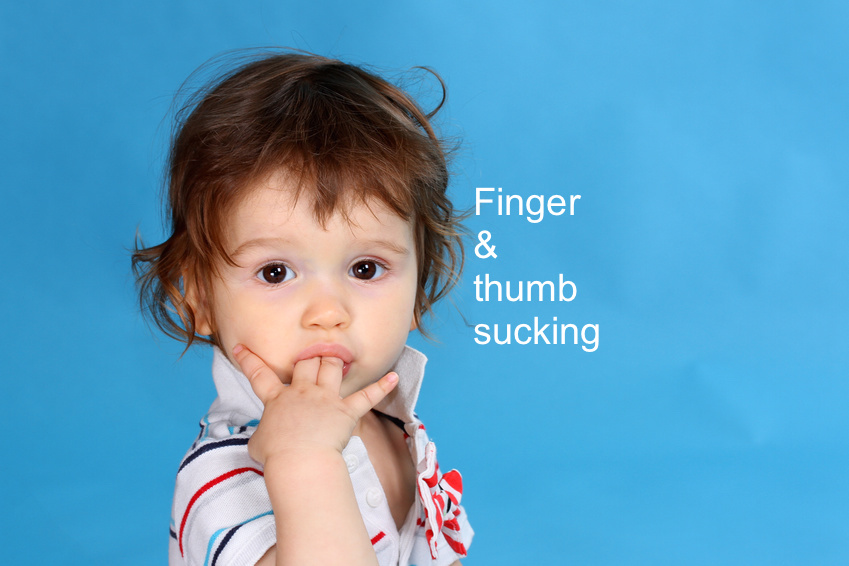
My daughter sucks her fingers!


Sucking fingers or a thumb is a self-soothing strategy.

Before I became a parent I had this mental list of “my child will never…” One of those specifically was “my child will never suck their thumb.” I was really against it and thought it was a “bad habit” kids had.

Once Emily arrived she quickly refused the dummy and decided to suck her fingers instead. I guess technically it wasn’t her thumb!! At first I was really concerned as I had images of my beautiful little girl having horrendous bucked teeth.

Once learning more about infant sleep, I realised that finger and thumb sucking was in fact the perfect “self-settling tool” as the sucking sensation calms and soothes. It was something she could do for herself. Emily was an excellent sleeper and the finger sucking was only for sleep, not all through the day.

Fast forward and Emily is now 5. Recently we visited a dentist and we were told her front teeth were starting to move forward. She advised us that stopping this habit was best done prior to her permanent teeth coming though.

I was dreading tackling this issue because Emily was such a great sleeper and I didn’t want to mess with that, also I didn’t want her to be upset. I’m such a wimp!

So operation finger sucker began…

1)    Talk – In the lead up to preventing Emily from sucking her fingers during the night we talked a lot about why we needed to stop the habit. I showed her a couple of pictures of children on the Internet that had bucked teeth. This wasn’t to scare her but to help explain what we were trying to prevent.

2)    Reward – We talked about what we could do to reward her for not sucking her fingers. She decided she wanted to have earn a lolly every morning she didn’t suck her fingers. After 10 mornings, she wanted to go ten-pin bowling. Yep, I wouldn’t have picked that one!

3)    Begin small – For a fortnight before starting, Emily stopped sucking her fingers during story time. This was difficult but not impossible for her. Giving lots of praise was crucial.

4)    Tool – I decided Emily needed a tool to help her, as just asking her to not suck her fingers would be impossible plus I couldn’t watch her all through the night to check. I bought a “T-Guard™” which is basically a device that slips over the fingers (or thumb) to prevent suction. It is this suction that is comforting and pleasurable for children. It is the suction that pulls the teeth forward.

So with everything in place, we started “operation finger sucker”. I am shocked that Emily is doing so well. We are 5 nights into it and so far so good. Not being able to monitor everything that is going on is tricky, so I have to hope that it is working. I wish I had a video monitor!!

Emily is not thrilled about no longer sucking her fingers but she is settling really well at night and after a few early mornings, she is right on track. She is excited every morning to get a lolly in her bag plus a step closer to bowling. It is recommended she wear the guard for 45 nights so I guess we have a long way to go.

Sleep well.

Janelle Jeffery Child Sleep Consultant for Sleepytime Child Educator and Behaviour Specialist.
Janelle Jeffery
Child Sleep Consultant for Sleepytime.

Toddlers who climb out of their cot

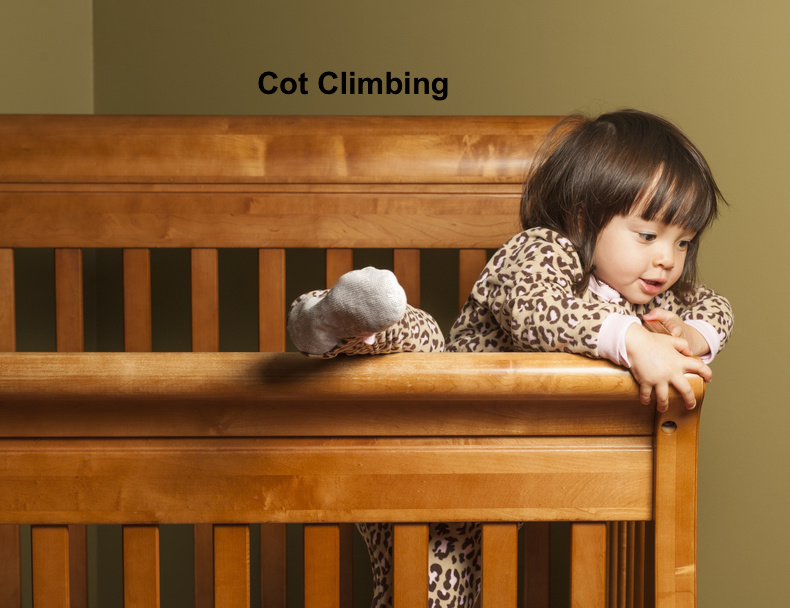
Cot or crib climbing can be scary for parents.

The first time your toddler climbs out of their cot can be really terrifying. Safety is paramount and it should never be ignored. Before you rush into buying a bed, there are a few things you can try first.

I am not a huge advocate for transferring toddlers immediately to a bed because many children under the age of 2.5years are not ready to understand the rules of being in a bed. There is always a honeymoon period whereby toddlers stay in bed, but before long your toddler has free roam of the house and that can be a bigger safety issue than climbing out of their cot.

If your toddler climbs out of their cot or attempts to climb out, here are a few tips and tricks to try:

1)    Find a sleeping bag that has limited legroom. This restricts access to your child being able to lift their leg and climb out.

2)    Lower the mattress. Some cots have a variety of height levels for the mattress. Make sure it is at the lowest level making it higher and harder to climb out.

3)    Remove any pillows, blankets or toys that can be used as leverage to get out. This may also include a dresser or drawers that butt up to the cot.

4)    Some cots are designed to have one side that is higher than the other. This side is usually pushed up against the wall. If you have this style of cot, turn it around so the outer side is higher making it more difficult to climb.


So you have tried all these things and your toddler is still climbing. This is what to try next:

1)    If you have a video monitor, every time your toddler attempts to climb out, either say “no” over the monitor or go into the room and say “no”. You may need to do this over and over again. Do not get into a long conversation about why they need to stay there. Simply “no” or “no climbing” and that is it.

2)    If you do not have a video monitor, keep the door ajar so you can still see your toddler. Every time they attempt to climb out, go into the room and say “no”. Again you may need to do this over and over again.

3)    If you are worried that your toddler may climb out once you are asleep, then make sure they have a safe landing. Many climbers can actually do it very safely. I recommend placing a mattress on the floor so they are not hurt if they do make it out of the cot.


If your toddler does manage to “escape” always walk them back, place them back into the cot and say, “no climbing”. Again you may need to repeat this over and over again. You need to be patient, calm and persevere.


It can be tempting to pack away the cot and buy a bed, but trust me, I have worked with many parents who find themselves with a toddler always hopping out of bed and either crawling into their bed or turning on the television at some crazy hour of the night. It can be even more dangerous if you have stairs or outside doors that can open easily. It is much harder to keep a toddler contained once they are in a bed.

If you have tried all these tips and tricks and you are still finding your toddler is climbing out, contact me here.

Janelle Jeffery Child Sleep Consultant for Sleepytime and Child Behaviour Specialist.
Janelle Jeffery
Child Sleep Consultant.


Is there method in your madness?

Have you felt like you have tried every method ever invented?


When I speak with frazzled parents about their child’s lack of sleep, I am always asked “I have tried everything and nothing has worked so why are you different?” and, “Do you practice “cry it out?”

I have considered this a lot lately because the “method” you use to help a child become an independent sleeper is engulfed in controversy. Everyone has an opinion and it is a polarising subject.

I want to let you in on a secret – it is not the method that is standing in the way of your child’s sleep success.

It doesn’t matter if you use {insert your method here}, they are all going to eventually fail because of this one thing. You haven’t actually addressed the root of the problem. If you don’t understand WHY your child is having difficulty sleeping through the night or is cat napping during the day, then whatever method you apply will not work because you are focusing on the wrong thing.

You sure are feeling frustrated, because you HAVE tried every method ever invented but you still have a child who cannot sleep. How do you solve this? Simple, hire me!

The first step before I write any sleep program is to perform a full sleep assessment. This enables me to establish the cause of your child’s sleep issue or issues. I make those necessary changes first. Next I look at establishing 5 sleep cues to prepare your child for sleep. The very last thing I decide upon is the method to achieve long-term sleep success.

So if you are tired of being tired and actually want to see the light at the end of the tunnel, contact me here. Change is ready for the taking, you just need reach out for my help.

Janelle Jeffery Child Sleep Consultant for Sleepytime
Janelle Jeffery
Child Sleep Consultant for Sleepytime