Many of you twice year need to prepare yourselves for daylight savings. As an adult this can be hard enough, but trying to tackle it with a child’s sleep schedule to consider and be a nightmare!! Here are some quick tips to help with the transition…
Surviving Daylight Savings!
Daylight Savings
For a gentle approach, adjust the time by 10-30minute increments every 3 days. Depending on your child’s ability to stay awake without becoming too overtired will determine the speed at which you make the change. Every child is different so you need to watch and observe. This gentle time change applies at the beginning and end of daylight savings.
If you are brave, change to the new time immediately but this can cause overtiredness. For a little while you child might protest at sleep time or cat nap. Hang in there and don’t panic. The more you try to “fix” things, the more problems you could create.
Watch for tired signs especially at night. An overtired child will have difficulty falling asleep and staying asleep. Due to the change in sleep schedule, your child may experience night wakings for a short period too. Again, don’t panic! Let things rectify on their own.
Be patient. Change takes time. It may take up to a month for your child’s body to fully adjust.
Early morning wake ups. Try really hard to keep your little one in bed until a reasonable wake up time. These wake ups may be the most difficult so hang in there, it will get better.
Use light and darkness to your advantage. Use lots of sunlight and fresh air to stay awake, use darkness to get to sleep.
The biggest thing to avoid for yourself and for you child is to constantly refer to the “old time”. The quicker you move to the new time the better it will be for all of you.
Janelle Jeffery Child Sleep Consultant for Sleepytime.
How many times have you been asked, “So, is he sleeping through the night yet?” It seems that sleeping through the night is some kind of measure of success as a mother. If your baby isn’t sleeping through then what are YOU doing wrong? Cue all feelings of guilt and failure now…
What does sleeping through really mean?
Everyone seems to have his or her own interpretation of what sleeping through the night means. Some people say it’s 5 straight hours, others say 12hours. I believe, once a baby enters the cot at night, say around 7-8pm, and self-settles through the night (not needing help from mum or dad to fall back to sleep) and wakes any time after 6-7am, is sleeping through the night. As adults, we will wake up through the night from time to time when we are in the light phase of sleep. Babies need to wake too; it’s just that they are a little noisier about it. If your baby has managed to fall back to sleep independently then they are sleeping through!
So, what about feeding through the night? Babies need to be fed through the night. Some babies will drop the night feed as early as 3months old and some babies will still require a feed at 8months old. If your baby is waking through the night for one to two feeds but he can fall back to sleep all on his own after the feed AND he can settle himself other times during the night, then I believe he is sleeping through.
When should my baby be sleeping through?
All babies are different. As said earlier, some babies will drop all night feeds as early as 3months old and can resettle themselves without the help of mum or dad and will sleep 12hours straight. This is not the norm. Lots of babies (if everything goes to plan) will start sleeping through and not needing a feed at about 6months old. Some babies will take a little longer.
If your baby is waking frequently during night needing to be fed back to sleep, rocked, cuddled, bounced etc then maybe it is time to seek help. Good quality sleep is vital for healthy development. Asking for help isn’t a sign of failure as a parent.
Every baby is different and sometimes all you need is a little guidance and support from someone in the know. Book here to have a chat together. During this time we can discuss the needs of your child, the support I offer and how you can achieve sleep success in a caring and loving way! Sleep well!
Janelle Jeffery Child Sleep Consultant for Sleepytime.
Increasing the bond between baby and daddy is so important.
The first few months, when your bundle of joy first arrives home with you, is about establishing the bond between mother and baby. This usually occurs during the breast-feeding process. This can equally happen when your baby is bottle-fed, but again most mothers feed their baby far more than dads do. Often dads feel a little left out and over time don’t really know how to become more involved in the process. Fast forward 12months and still bedtime is about mummy and baby with dad being excluded altogether.
The longer dads are left out of the bedtime and settling process, the harder it can become. First of all, it just becomes habit or the norm for mum to tackle the bedtime routine and night wake ups. Secondly dad just loses confidence and really doesn’t know what to do because he feels he doesn’t have “the right equipment”.
There are lots of ways dads can become highly involved with their baby right from the beginning. Breast-feeding is very important, but other than that, dads are capable of doing everything else from nappies, bath-time, story time and even putting baby to bed.
When I speak with parents, a lot of the discussion is about how to involve dad more. It is not because these dads are against helping, but they feel like they are making things worse because their baby seems to protest more until mum comes in to rescue them. Here is a simple example of how to involve both parents at bedtime:
Bath time and massage (Dad)
Nappy and pyjamas on (Dad)
Breast-feed (Mum) and Story (Dad)
Kisses and cuddles (Mum). Mum leaves.
Kisses and cuddles (Dad)
Into the cot (Dad)
As many dads work, evening is the only time to spend with baby. Quality bonding time is crucial. Being included in the bedtime routine is far more beneficial for baby rather than playing before bed when baby is clearly tired.
When baby wakes in the night, unless it is a “feed time”, dad can help to resettle all other times. As a mum myself, I often took the ‘night-shift’ because my husband worked long hours and I could take a nap during the day to catch up on sleep. I totally understand this way of thinking. What if this is not about who needs sleep more BUT about increasing bond time with your baby? Leaving the settling up to one single person really limits the possibility of your baby bonding equally with both parents.
Just because your baby is breast-fed, this should not determine who does all the settling and who does the bedtime routine. Sleep should not be the sole responsibility of one parent. Share the load and share this amazing bonding experience equally.
Sleep well,
Janelle Jeffery Child Sleep Consultant for Sleepytime
Have you felt like you have tried every method ever invented?
When I speak with frazzled parents about their child’s lack of sleep, I am always asked “I have tried everything and nothing has worked so why are you different?” and, “Do you practice “cry it out?”
I have considered this a lot lately because the “method” you use to help a child become an independent sleeper is engulfed in controversy. Everyone has an opinion and it is a polarising subject.
I want to let you in on a secret – it is not the method that is standing in the way of your child’s sleep success.
It doesn’t matter if you use {insert your method here}, they are all going to eventually fail because of this one thing. You haven’t actually addressed the root of the problem. If you don’t understand WHY your child is having difficulty sleeping through the night or is cat napping during the day, then whatever method you apply will not work because you are focusing on the wrong thing.
You sure are feeling frustrated, because you HAVE tried every method ever invented but you still have a child who cannot sleep. How do you solve this? Simple, hire me!
The first step before I write any sleep program is to perform a full sleep assessment. This enables me to establish the cause of your child’s sleep issue or issues. I make those necessary changes first. Next I look at establishing 5 sleep cues to prepare your child for sleep. The very last thing I decide upon is the method to achieve long-term sleep success.
So if you are tired of being tired and actually want to see the light at the end of the tunnel, contact me here. Change is ready for the taking, you just need reach out for my help.
Janelle Jeffery Child Sleep Consultant for Sleepytime
If I buy shoes that are too small for my daughter or push her into activities that she doesn’t enjoy or keep her away from the things that she excels at because it differs from what her peers wear/do/are good at does this mean I’m a good mother? Of course it doesn’t.
It is so easy to see in this example how expecting something from my daughter that doesn’t fit with her own unique comforts, interests, and abilities can begin to harm her physically, mentally, emotionally and spiritually.
I don’t see my role as a loving mother to coerce my daughter into a certain way of being or to tell her what she does and doesn’t need. It is my job to use my mothering instincts to listen very carefully and try all options available to me to create a safe, comforting, loving environment to encourage the optimal development of my little girl.
There is no doubt in my mind that you and all other mothers and fathers out there agree that we would do anything for the best interests of our children.
So why do we throw stones when one parent doesn’t push and force their beautiful baby into the mould that so perfectly fits our own baby – especially when it comes to sleep?
There is so much hate directed towards each other between the Cry-It-Out “dictators” and the Co-Sleeping “hippies”. My problem is not which method is chosen; my problem is why on earth does another baby’s needs bother you so much? (Notice how I said another baby’s needs?)
I’m not a sleep expert but I’ve tried almost all options available to me in order to help my baby girl to have restful sleep. We have all heard the horror sleep stories and I’m at neither extreme of the sleep scale but I suppose you could say my bub was closer to the no-sleep end of the spectrum.
Like some of us, I like a certain level of control in my life, and as diligent pregnant women I casually researched and talked to other mums to get advice and ideas on how to best raise our child. Before she was born, my husband and I compared notes and had a general idea of which direction we would want to take and how we could best implement these ideas.
Then our beautiful baby was born. I cuddled and hugged her, fed her to sleep, I laid down with her, I kept her by my side in a bassinet, I jumped at every murmur to feed, and cuddle and let her know I was with her. My husband stayed awake with us at every feed and every wake-up to let her know that he was there also. I carried her against me as much as I could.
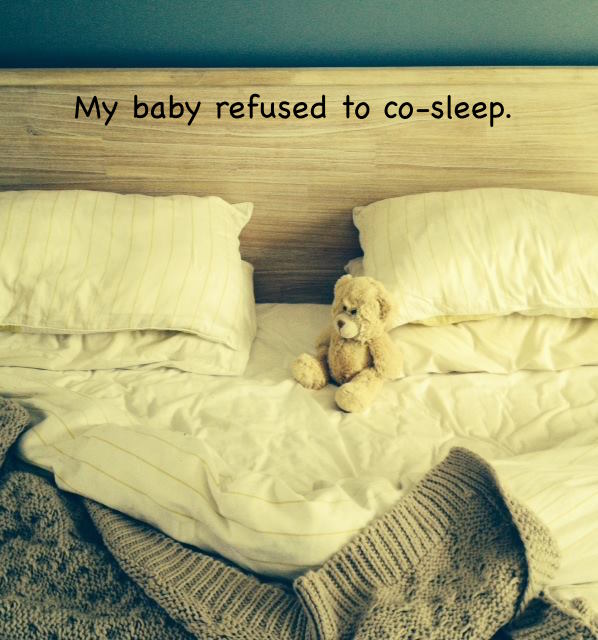
She hated it. She cried and cried. Didn’t sleep in the car, didn’t sleep in the carrier, didn’t sleep in the pram, didn’t sleep in my bed, didn’t sleep in my arms. The only time she did sleep in any of these locations is only after crying until she was exhausted.
I thought I was doing the right thing by holding her close, showing I was there for her and living with her on me. It’s what she was used to after being in my belly for over 9months, it’s what she is supposed to want – right?
As a Registered Nurse and a Kinesiologist, ruling out a medical issue was first on the list. So if not that, then what was it? Why did she not do as the books said she would do? Why did she not like what the ‘experts’ said she would like?
It’s because she isn’t the print within the pages of a book, she isn’t a science experiment, she isn’t your child or your friend’s child, she is my child and she likes what she likes, and doesn’t like what she doesn’t like.
After 4 months of experimenting and trial and error, my husband and I were none-the wiser on what to do. We tried to co-sleep, we tried rocking her to sleep, we tried having her next to us in a bassinet, we tried having her outside our bedroom door, tried her in her own room and then briefly tried the cry-it-out method with friends and family there to monitor it with us – nothing worked and she would just cry herself to sleep.
It was heartbreaking – not to mention exhausting – to see our little girl struggle to get to sleep no matter what we did.
As corny as this may sound I couldn’t believe that I was unable to love-her to sleep like I was yearning to. She was, and still is such a bright, attentive, curious and happy baby by day but at naptime and bedtime it was an hour/s long process.
At this point, as with most 4-month olds, her development reached a new milestone, meaning her already short naps were getting less frequent and she began waking up more at night.
We knew it was time to get professional customised support but I was terrified of calling a sleep consultant.
I thought that I would have to re-live the cry-it-out torture but the thought of continuing to pace and rock my little girl to sleep while she cried and fought sleep for 40 minutes (after an hour-long breastfeed to get her sleepy) and then starting that whole process again after she woke 15minutes later pushed my sleep-deprived mind into making that call, booking that skype chat and listening to what our consultant, Janelle had to say.
Janelle was so thorough and created such a specific and personalised plan for our girl that I felt that maybe she could help us. I was doubtful that such a simple process could work seeing as I felt like I’d tried everything already, however we completed the program and it worked!
I cannot explain how it worked, other than seeing for myself that by rocking her in my arms I was assuming that she needed me to fall asleep, I was trying to make her fit into a mould of what I thought a baby’s sleep time should be like, but it turned out that I was hindering her and not meeting her unique needs.
I didn’t just learn how to help my daughter to sleep; I let go of my guilt and assumptions and let my daughter be her. I accepted her for what she needed from me and for what she didn’t. After changing my approach, she fell asleep within a fraction of the time; she was being put in bed awake and falling asleep on her own.
Nowadays my girl is 18 months old and still whines on falling asleep it’s just her way.
I’ve interrupted her whining-to-sleep process and asked if she was ok and she said “yes” and if she wanted me to leave and she said “yes”.
She now sleeps peacefully in the car, carrier, pram and bed but still doesn’t like the stimulation of physical contact when going to sleep. Luckily she makes sure she gets her fill of kisses and cuddles while she is awake!
Kate Lethbridge – Guest Blogger for Sleepytime
Kate Lethbridge is a Registered Nurse, Holistic Kinesiologist, Mind Body Medicine practitioner and mother who has a passion to facilitate others to achieve their biggest goals one-by-one by helping her clients become their ultimate self physically, mentally and emotionally.
For more about Kate and her services visit the following pages:
All opinions represented within this article relate to the best interests of the author, her family and her child – please make your own health care choices are based on the best interests of your own child/ren and family. Most of all, please respect the needs of other babies and don’t throw stones at their mums.